 Back to Blog
 Best Smart Bulbs in 2026: RGB vs Tunable White vs Filament Compared
Smart lighting is one of the easiest upgrades you can make in a home, but it’s also where most people overspend or choose the wrong bulb type entirely. RGB bulbs promise millions of colors, filament bulbs promise vintage charm, and tunable white bulbs promise better daily lighting, but those promises don’t mean much without real-world comparison.
In this review, we tested RGB color bulbs, tunable white bulbs, and filament-style smart bulbs across brightness, color accuracy, protocol stability, and value. The goal wasn’t to crown the most expensive option as the winner. It was to identify what actually performs best in normal homes. If you’re deciding which ecosystem to invest in, this is the comparison that matters.
Products Tested (Specs & Pricing)
Below are the models included in this comparison. Prices reflect typical 2026 retail ranges.
RGB Bulbs
| Brand | Model | Lumens | CRI | Protocol | Approx Price |
| Philips Hue | White & Color (Flagship) | ~1100 lm | 80 | Zigbee / Thread / Bluetooth | $45–55 |
| Philips Hue | White & Color Essential | ~800 lm | 80 | Zigbee / Bluetooth | $25–30 |
| IKEA | KAJPLATS RGB | ~1055 lm | 90 | Matter (Thread) + Zigbee | $12–15 |
| WiZ | RGB WiFi | ~800 lm | 90 | WiFi | $15–20 |
| Nanoleaf | Essentials RGB | ~1100 lm | 90 | Thread (Matter) / WiFi | $20–30 |
| Govee | RGB E27 | ~800 lm | 90+ | WiFi / Bluetooth | $10–15 |
Tunable White Bulbs
| Brand | Model | Lumens | CRI | Range | Approx Price |
| Philips Hue | White Ambiance (2025) | ~1100 lm | 80 | 2200K–6500K | $40–50 |
| IKEA | KAJPLATS Globe | ~1521 lm | 90 | 2200K–6500K | $10–15 |
| WiZ | Tunable White | ~800–1000 lm | 90 | ~2700K–6500K | $15–20 |
Filament Smart Bulbs
| Brand | Model | Lumens | CRI | Type | Approx Price |
| Philips Hue | Filament | ~550 lm | 80 | Warm only (~2100K) | $20–25 |
| IKEA | KAJPLATS Filament | ~470 lm | 90 | Tunable | $8–10 |
| WiZ | Filament (Clear/Amber) | ~640 lm | 90 | Tunable | $15–20 |
Protocols Explained (Why This Actually Matters)
Before comparing light quality, it’s important to understand how these bulbs connect.
Zigbee, used heavily by Philips Hue and supported by IKEA, is a low-power mesh network that requires a hub. The upside is excellent reliability and instant response times, especially as you scale to many bulbs. The more Zigbee devices you add, the stronger the network becomes.
WiFi, used by WiZ and Govee, connects directly to your router without a hub. It’s simple and accessible, but routers can struggle when managing large numbers of connected devices. For small installations, it works perfectly; for whole-home deployment,s it requires stronger networking hardware.
Matter and Thread are the newer standards. Nanoleaf and newer Hue bulbs support Matter over Thread, while IKEA KAJPLATS supports both Thread (Matter) and Zigbee. Matter allows cross-platform compatibility between Apple, Google, Amazon, and others. Thread provides low-latency mesh networking similar to Zigbee but requires a Thread border router in your home.
Protocol choice isn’t about hype. It determines long-term stability.
RGB Performance Comparison
All RGB bulbs were tested side-by-side in identical fixtures under the same indoor conditions. Evaluation focused on color accuracy, saturation, smooth transitions, and white-light rendering.
Red Performance
Red exposes cheap color mixing immediately. Lower-quality bulbs often drift toward orange or pink, especially at higher brightness levels.
The Philips Hue flagship model produces the cleanest red in this group. It remains saturated and neutral without visible tint shift, even near maximum output. WiZ performs surprisingly well here, delivering bold red tones that come close to Hue in vibrancy, though with slightly less depth.
IKEA KAJPLATS handles red impressively, given its price, but direct comparison reveals marginally less refinement. Nanoleaf’s red sits between IKEA and Hue in tonal precision. Govee is perfectly usable for accent lighting, but lacks the richness of higher-tier models.
Green Performance
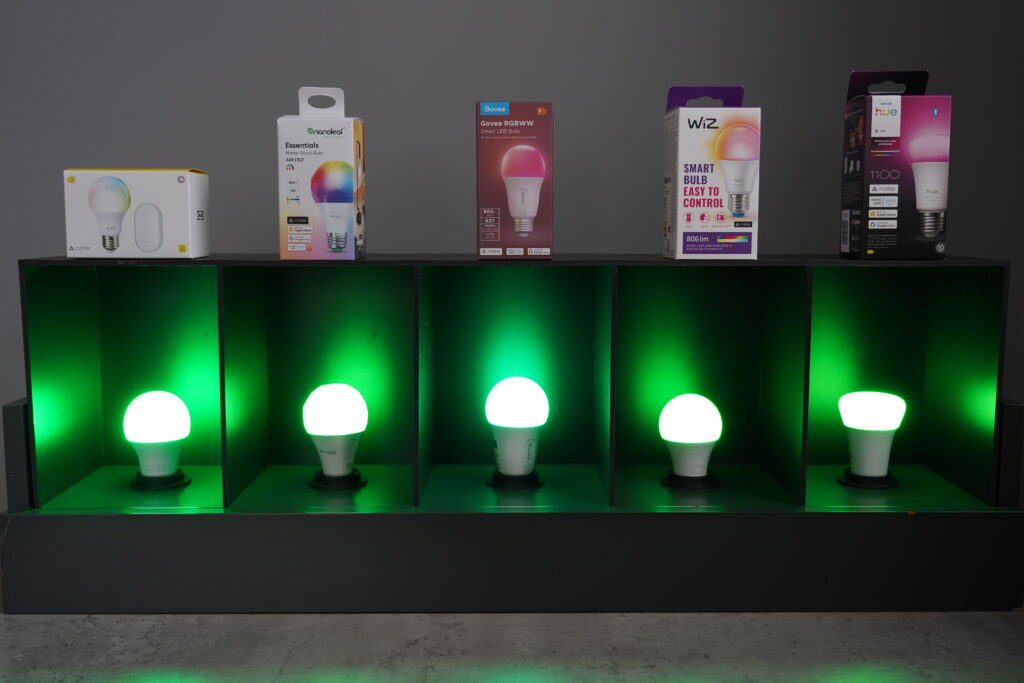
Green often reveals calibration shortcuts, showing yellow undertones in weaker bulbs. Hue maintains a clean, saturated green without drifting warm. IKEA performs strongly but shows a faint yellow shift in direct side-by-side comparison. WiZ offers good brightness but slightly less tonal consistency at higher levels.
Nanoleaf handles green well and remains balanced across brightness ranges. Govee delivers solid intensity for the price, though fine accuracy is not its strength.
Blue and Purple Performance
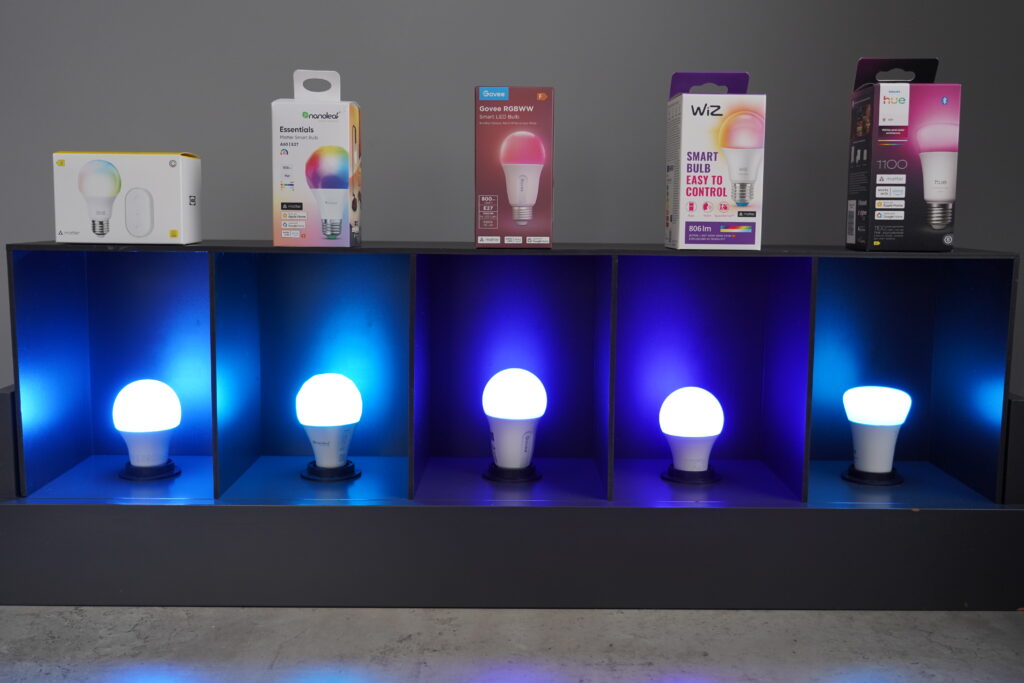
Blue is particularly challenging because weaker RGB mixing often produces unwanted purple shifts.
Hue delivers a deep, stable blue with strong contrast. Nanoleaf performs close behind, offering impressive depth and saturation. IKEA’s blue is bright but slightly flatter in comparison.
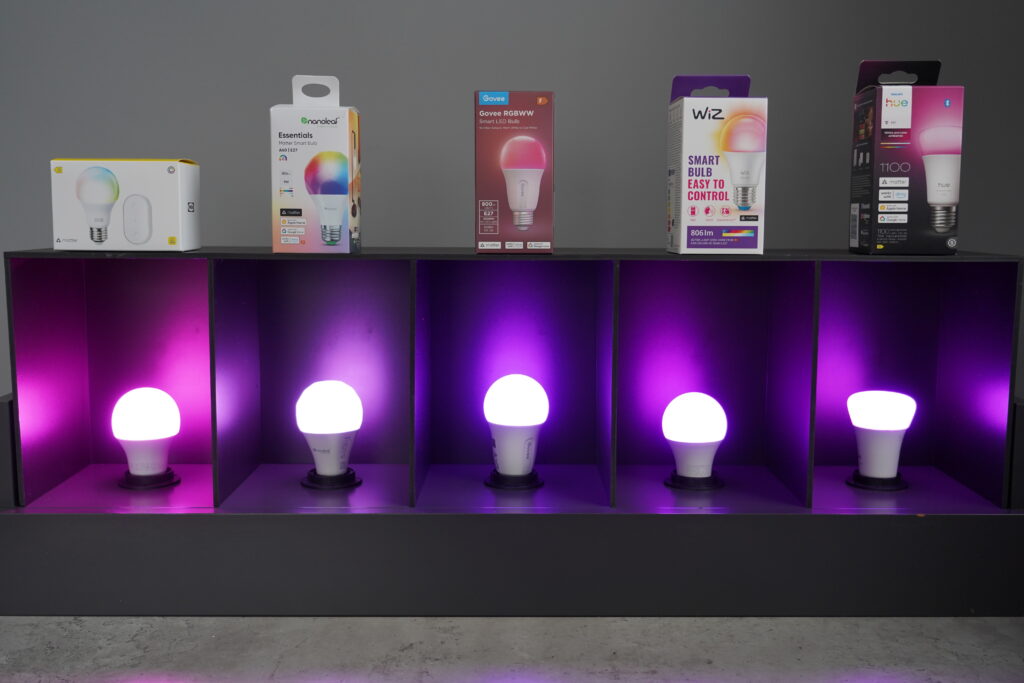
Purple and secondary colors expose algorithm differences. Hue produces clean blends without muddiness. WiZ actually excels in bold purple tones, sometimes appearing more vibrant than expected. Govee performs acceptably but loses nuance in lighter shades.
White Light from RGB Bulbs
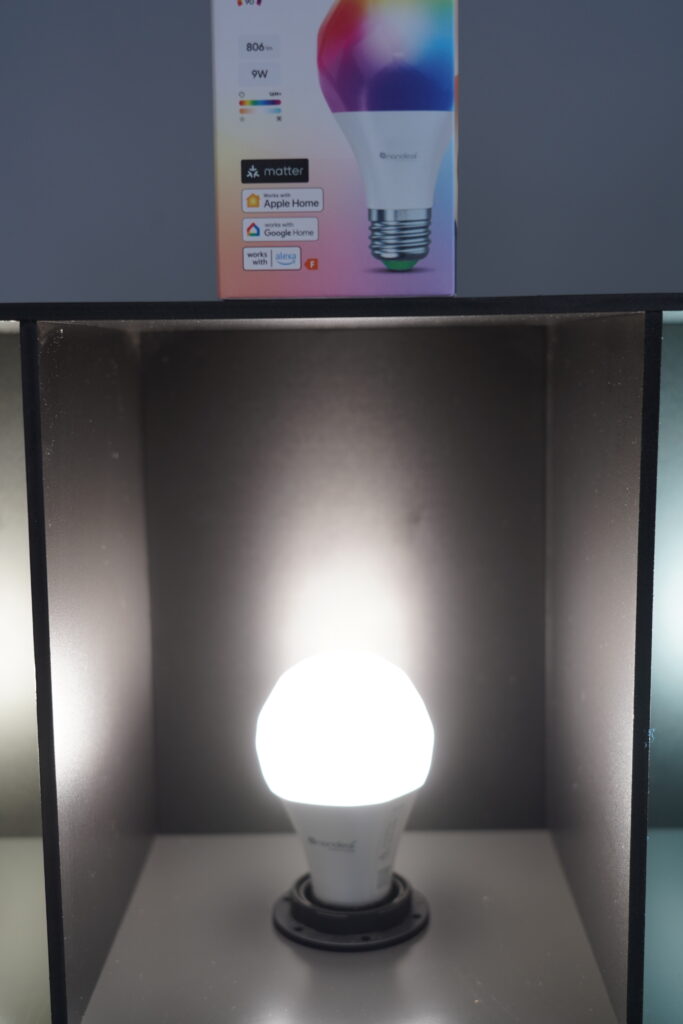
RGB bulbs must compromise to fit red, green, blue, and white LEDs into one housing. As a result, none of them match dedicated white bulbs.
Hue maintains the most neutral white across 2200K–6500K. IKEA performs well at mid-range temperatures but shows tint shifts at extremes. WiZ remains acceptable but becomes overly orange at full-brightness warm settings. Govee struggles most with smooth white calibration.
If white lighting is your priority, tunable white bulbs are the better investment.
Tunable White & Filament Comparison
Unlike RGB bulbs, tunable white models focus entirely on delivering quality white light across temperature ranges.
Warm White (2200K–2700K)
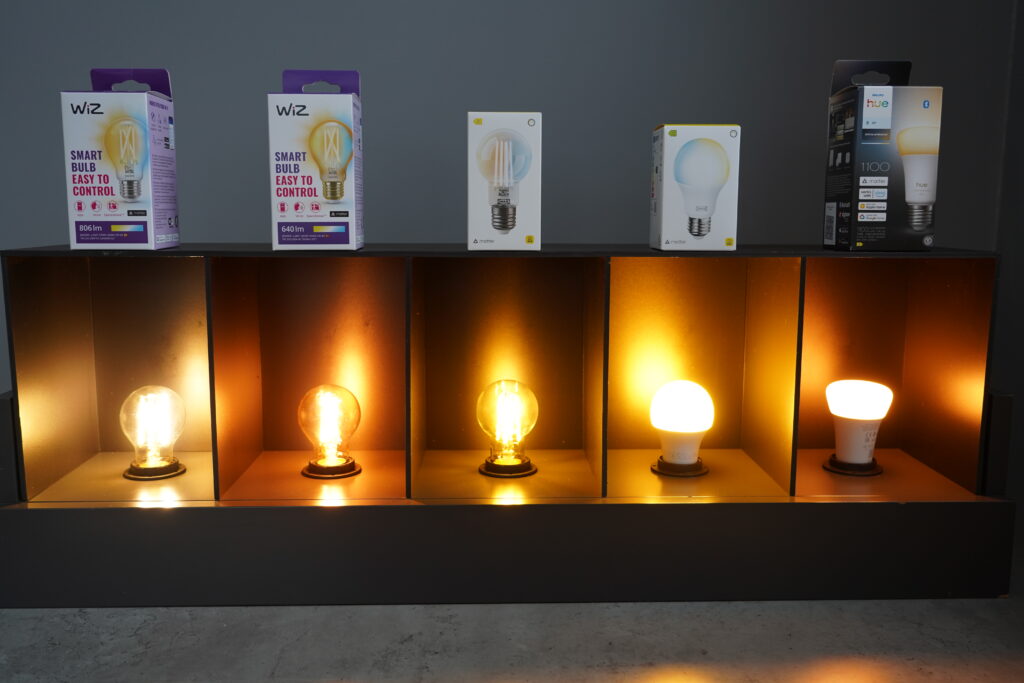
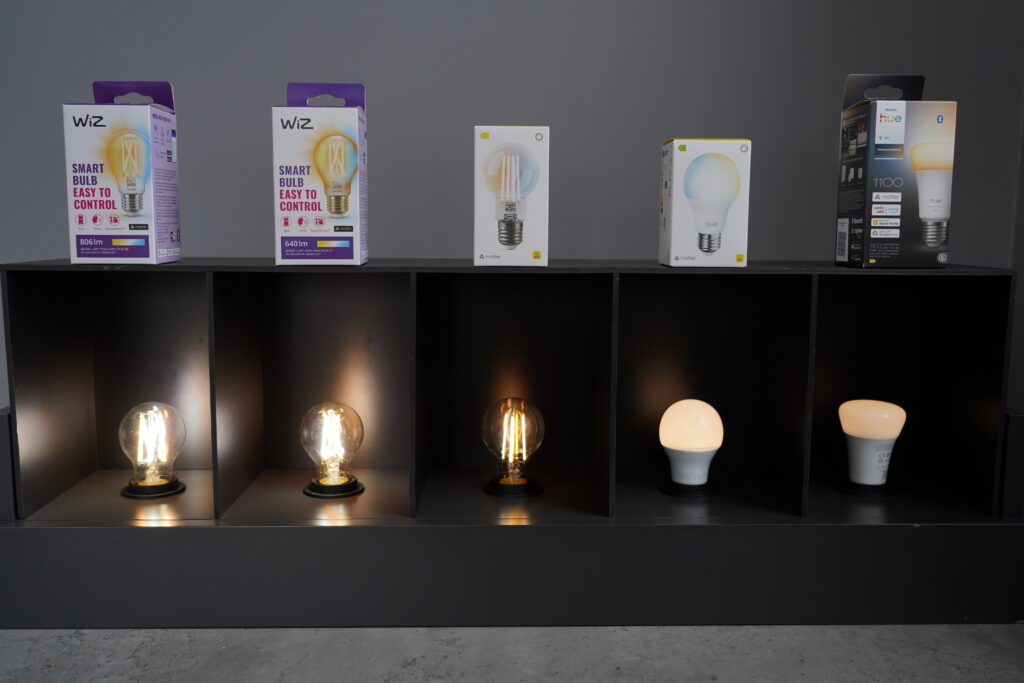
At warm temperatures, Hue produces a smooth golden tone without excessive orange. Its deep dimming capability is particularly impressive, allowing near-nightlight levels without flicker.
IKEA’s KAJPLATS globe delivers excellent warmth at a fraction of the price, though subtle tint inconsistencies appear at extreme lows. WiZ produces a pleasant glow but can become overly intense at full brightness.
Filament bulbs emphasize warmth over brightness. Hue’s filament is beautifully stable but fixed in temperature. IKEA’s tunable filament offers flexibility at significantly lower cost.
Neutral to Cool White (4000K–6500K)
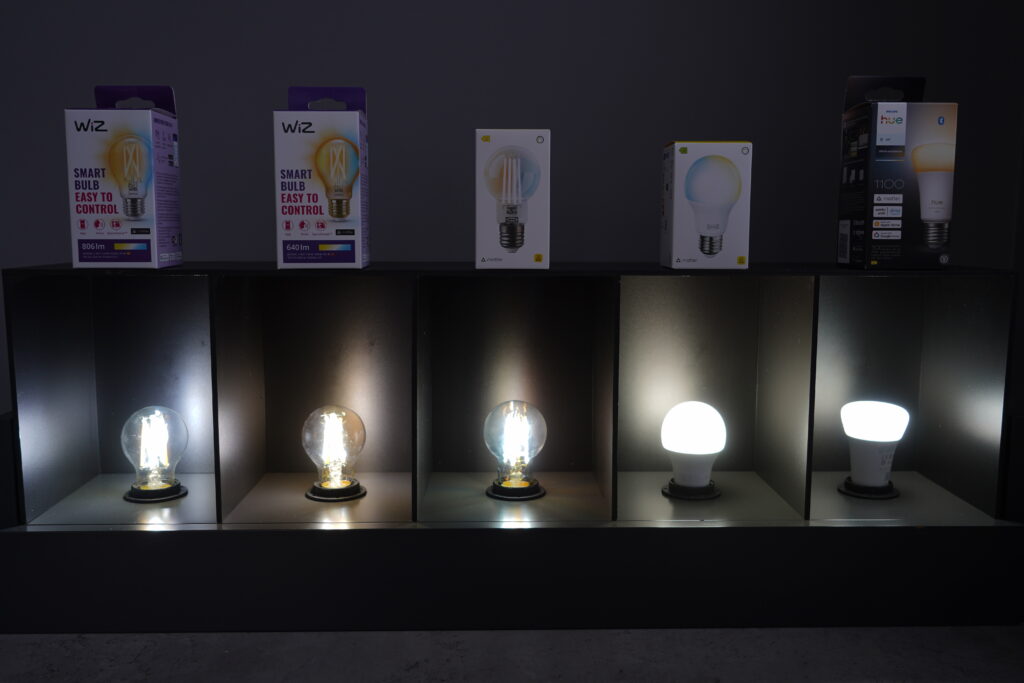
Hue remains the most neutral at cool settings, avoiding green cast and maintaining clarity. IKEA performs well through mid-range but shows a faint greenish shift near 6500K. WiZ handles cool light decently, but lacks the smooth transition quality of Hue.
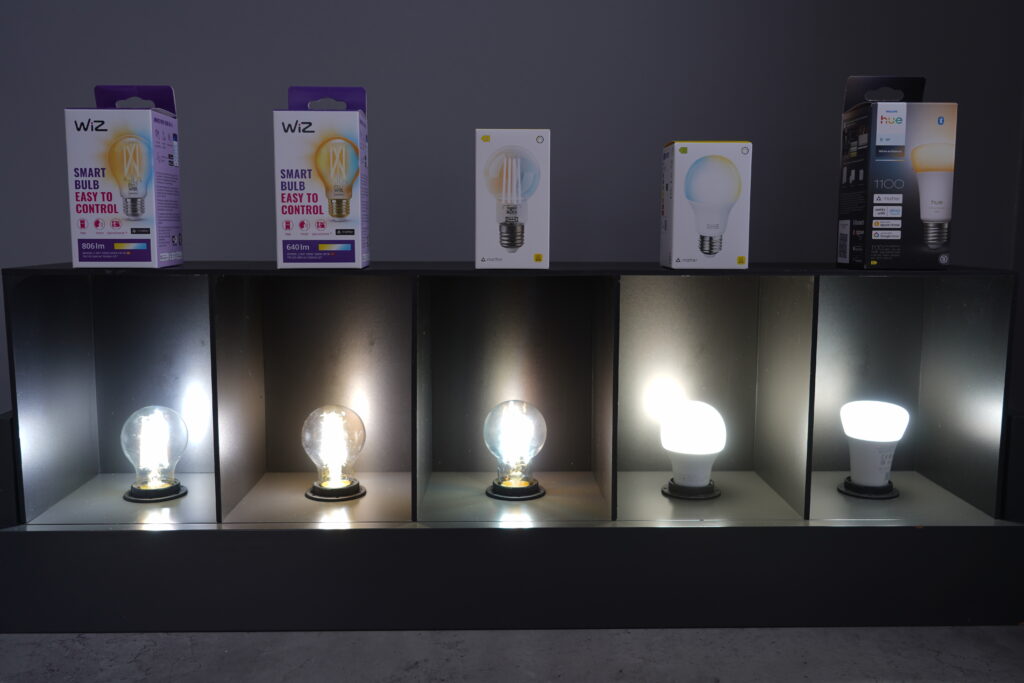
For everyday lighting in kitchens, offices, or bathrooms, tunable white bulbs clearly outperform RGB alternatives.
Wrapping Up
If you want the most accurate RGB color rendering and the strongest ecosystem stability, Philips Hue remains the benchmark. It’s expensive, but performance and reliability justify the premium.
If value matters most, IKEA KAJPLATS is the standout. Its RGB and tunable white performance are impressive at its price point, and Matter support makes it future-ready.
WiZ sits comfortably in the middle. It’s simple, reliable for smaller setups, and competitively priced. Nanoleaf offers strong specifications but carries mixed reliability reports. Govee remains a solid budget option for casual use.
The biggest takeaway is simple: RGB is great for accent lighting, but tunable white bulbs transform daily living spaces far more effectively. Choose the bulb type based on the room, not just the marketing.
If you want a smart home that feels premium, mix bulb types intentionally. Don’t install RGB everywhere, and don’t overpay where you don’t need to.
Similar Articles